Photography · Story
South to Magadi
Olorgesailie · Lake Magadi · Kajiado · 18 October 2026 · 4 photographs
I'd been meaning to go to Magadi for years. I've been to most of the Rift Valley lakes: Nakuru, Naivasha, Elementaita, Bogoria. I'd never been to the south end, where Magadi and Natron sit near the Tanzanian border. I hadn't been down into the Rift at all in about two years.
Magadi stayed on the list because it's far and it was new to me. Then one morning I woke up annoyed with myself and just went. That's how my best trips happen. When I plan, I plan forever. When I get the itch, I go, and it usually works out.
It wasn't the most sensible test drive. I'd replaced the car's computer the week before, so the trip doubled as the shakedown. I'd read that there isn't much water down there, so I loaded my 45-litre cooler with about 20 litres of water, a lot of ice, sodas and snacks. Most of it wasn't for me.
The road
After Corner Baridi the road changes. Every time I got up to 60, a pothole asked me to slow down again. You drop down the Rift escarpment on the way in and climb back up it on the way out. Past Olorgesailie the tarmac is new, and the last stretch to the lake was the smoothest road of the day.
It's also one of the most beautiful roads I've driven in Kenya. It took me back to Kilifi, riding a motorbike around the creek and finding spots with hills behind them. Same feeling, but the earth down here is redder.
The route · 18 October 2026
Down 1,430 m in about 80 km
- Corner Baridi
- 2,029 m · 12:41
- 1.464° S, 36.653° E
- 12:41
- Olorgesailie
- about 990 m · 13:42
- 1.578° S, 36.445° E
- 13:42
- Lake Magadi, at the dredge
- 601 m · 15:54
- 1.881° S, 36.272° E
- 15:54
Olorgesailie
1.578° S, 36.445° E · about 990 m
I stopped at Olorgesailie first, at about quarter to two, and took the full tour. The site sits on the floor of the Rift between two dead volcanoes, Mount Olorgesailie and Ol Esakut. Earth movements made a basin here over a million years ago, and a freshwater lake came and went in it until it drained away about half a million years ago. People made hand-axes along its shore for about half a million years. A geologist, J.W. Gregory, found the first ones in 1919, and Mary and Louis Leakey found the main site in 1942. Many still lie where erosion uncovered them.
In the museum, a column behind glass shows how the ground here is laid down, about a million years of it: 992,000 years old at the bottom, 49,000 at the top. Out on the site you see the real thing. Faults have broken and tilted the ground, so its layers show in the cuts and slopes: white, grey and red. I was told the white is diatomite, the skeletons of microscopic lake algae. There's so much of it that I think the road in runs through some. The grey bands are ash and pumice from eruptions nearby, and the ash buried the tools and bones fast enough to keep them. Part of a Homo erectus skull was found here, about 900,000 years old, with a carnivore's tooth mark on the brow.
The red bands, near the top, have the best story. The site's signs say they're diatoms and swamp plants buried in wet times, then burned by fires underground in very dry ones. The ground there was cooked from below.
Lake Magadi
1.881° S, 36.272° E · 601 m
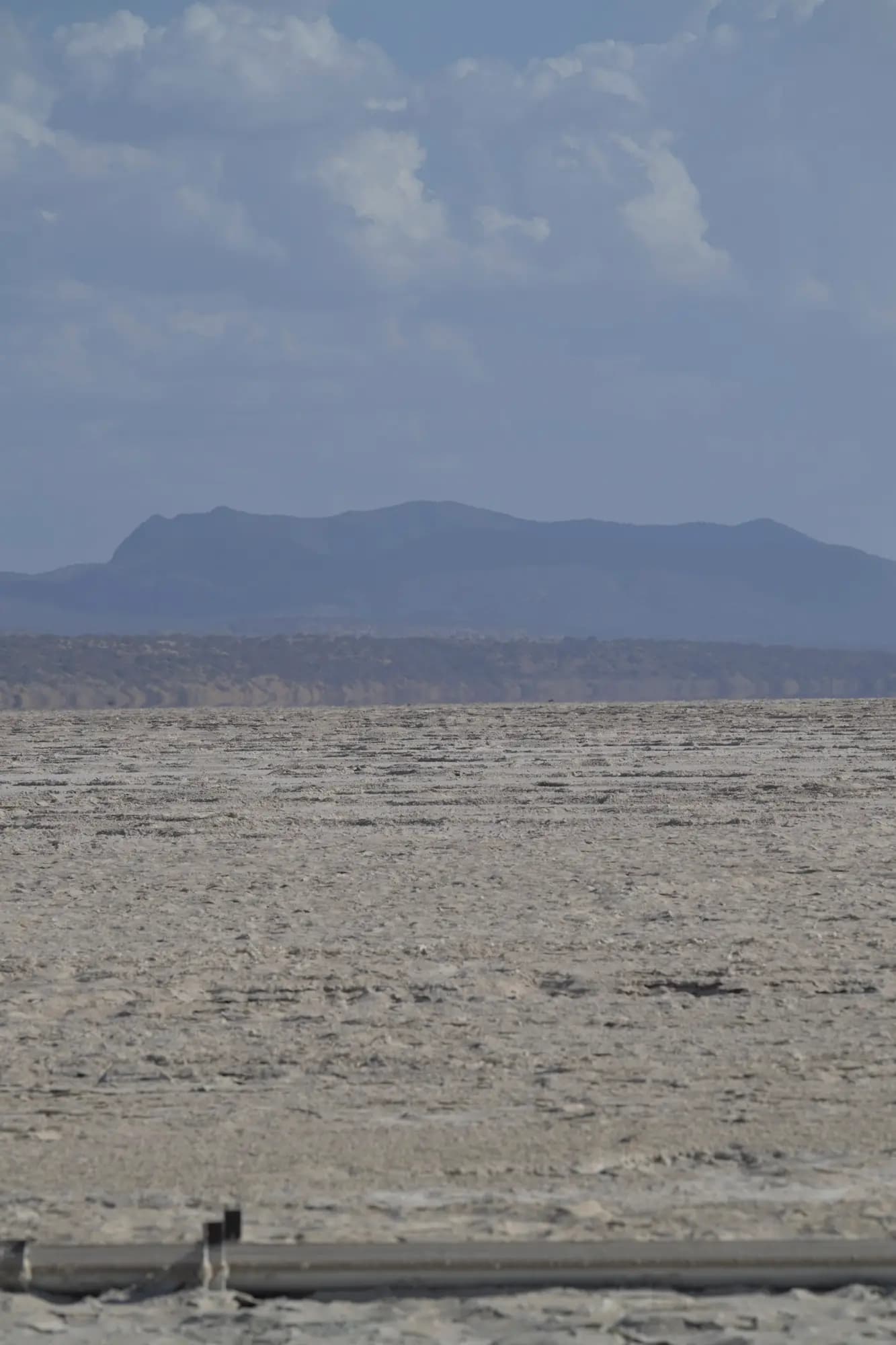
I reached the lake around half past three, and the heat hit first. The sun is direct, there's almost no shade, and the white ground throws the light back up at you. It's among the hottest places I've been.
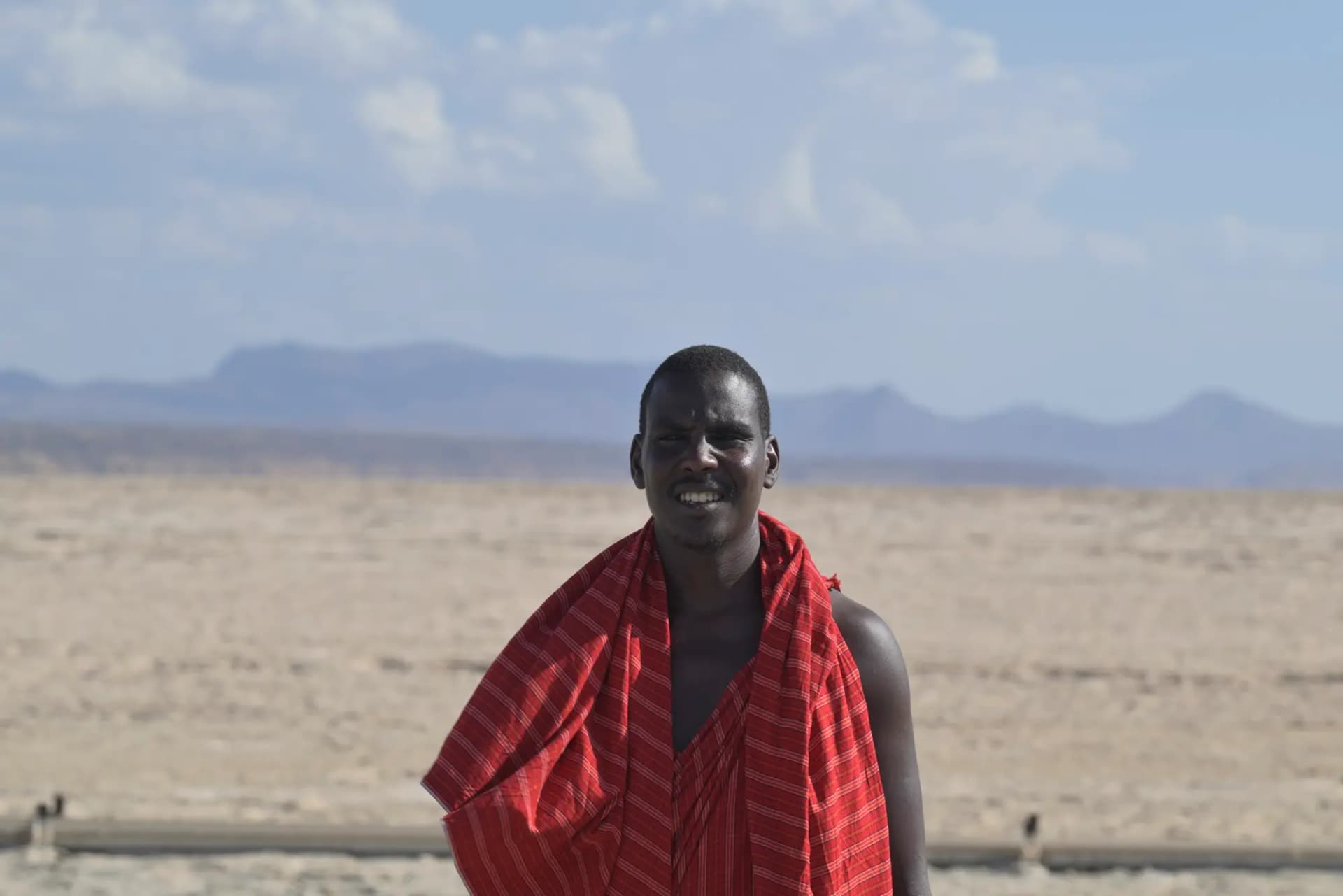
That's where I met Hillary, my guide. A guide is compulsory on the lake. They wanted to drive my car too, but let me keep the wheel once I explained about its new computer. He took me around the lake and explained what I was looking at.
From a distance the lake looks covered in white cloud, or like solid ground. It's neither. The white is trona, a sodium carbonate mineral that crystallises out of the brine. Hillary warned me that on the wrong patch, you sink. In the rains a thin layer of brine floods the pan, then evaporates back to white, so the level really does rise and fall.
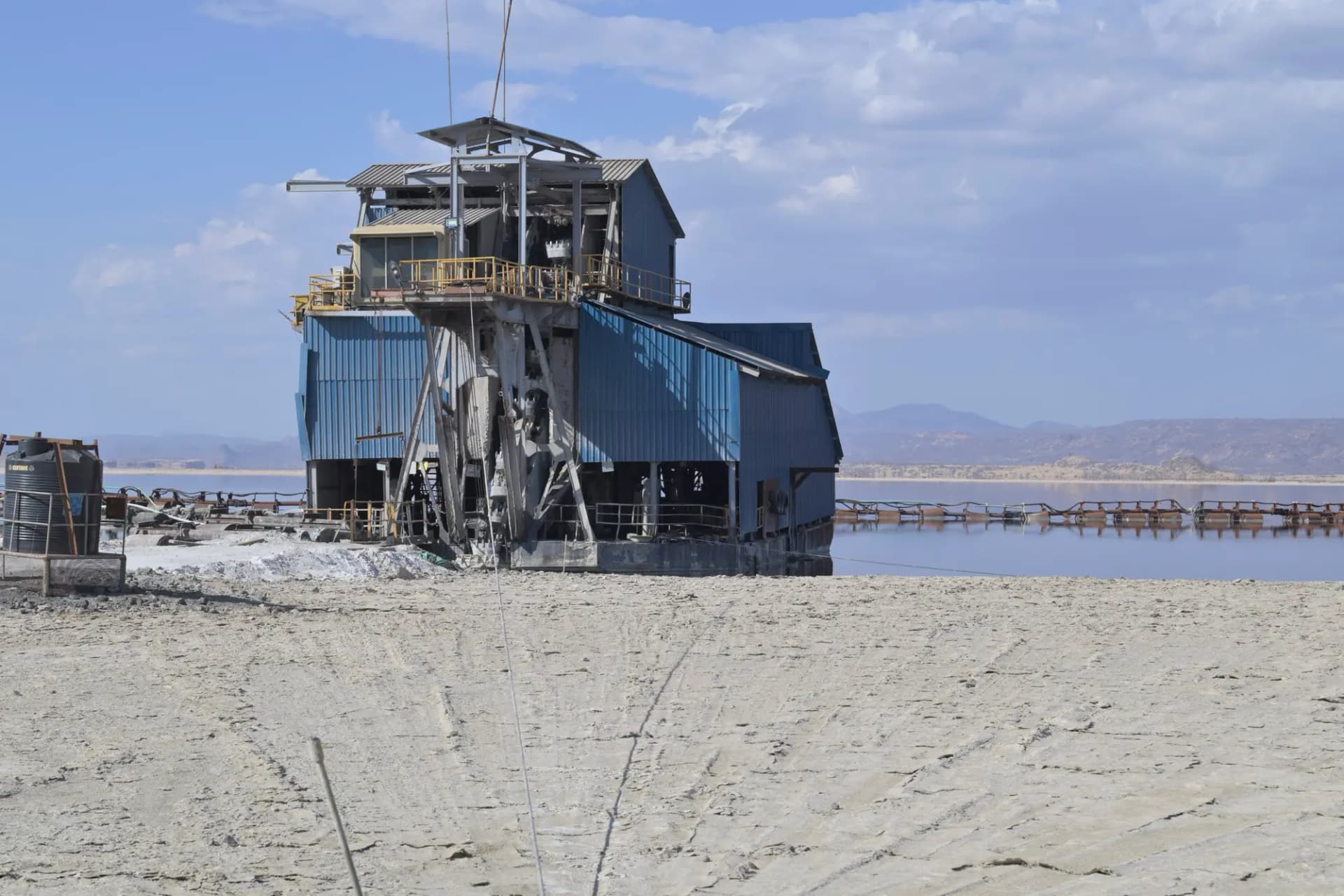
The dredge doesn't stand on anything. It floats in a pool it digs for itself: as it cuts the trona, brine from the surrounding crust drains into the hole, and the dredge moves forward into it. Hillary told me this one has been out on the lake since the 1970s, moving to wherever they want to mine next.
Inside the dredge, the trona is crushed, mixed with lake brine into a slurry, and pumped down those long pipes floating across the lake to the factory on the shore. There it's washed to get the salt out, which gives crushed refined soda. Rotary kilns then heat that into soda ash, which goes by rail to Mombasa and ends up in glass and detergent. Soda ash has come out of this lake since 1911, now under Tata Chemicals Magadi.
The strange part is that the lake keeps making more. Hot springs keep feeding it sodium, and the heat keeps evaporating the brine into new trona.
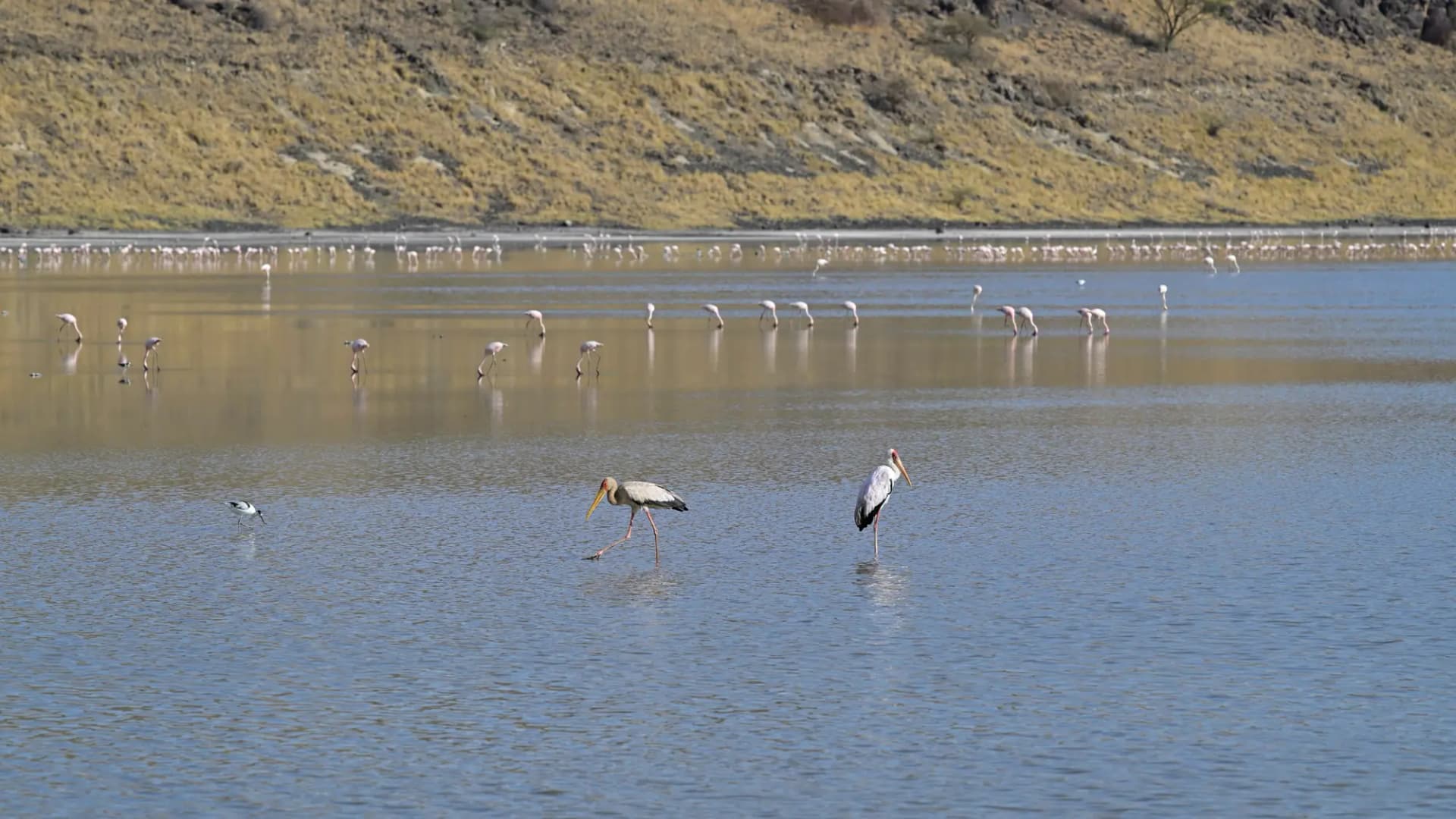
Before I left, I found the birds: a long line of flamingos feeding in the shallows, and yellow-billed storks wading closer in.
The smell
Then there's the smell. It's hard to describe, and it's strong, especially standing out on the lake. My best guess from reading afterwards is sulphur: in these alkaline lakes, bacteria break down algae and give off the rotten-egg smell of hydrogen sulphide.
Water
The cooler paid off. I handed out the water, ice and sodas to Hillary and his crew, and to the people and kids I met on the way out. Everyone was glad of it. If you go, carry more water than you think you need, and some to share.
The way back
I left around half past four, and I was tense the whole way. The car was still unproven, and I knew the last stretch would be dark and cold. There was a little drizzle near Olorgesailie. The car was fine. I got home at night.
If you go
A few tips:
- On the lake, the white ground isn't always ground. Go with a guide: it's compulsory, and they know which bits hold.
- Carry more water than you need, then some for everyone you meet. It will be the most popular thing in your car.
- From Corner Baridi, plan on about 60 km/h for most of the way. Don't count on many stretches where 80 is safe.
- Change lenses inside the car. Soda dust gets into everything, and the lens doesn't care that you're in a hurry.
- Don't photograph the soda works or its security. Photograph everything else.
Next time
Hillary is waiting for me to come back so we can carry on to Lake Natron. If you want to go to Magadi, message me and I'll put you in touch with him. He's a great host.